
Bike suspension plays a major role in how smooth, stable, and comfortable your ride feels. Whether you’re on a cruiser, stretch chopper, touring bike, or an e-bike full suspension model, the suspension system affects control and performance.
This guide explains the key suspension types—front shock, dual spring fork, and rigid fork—how they work, and who they suit best. We also cover modern full suspension systems and why they’ve become popular on e-bikes.
1. Why Bike Suspension Matters
Suspension is much more than a comfort feature. It affects:
- Ride smoothness
- Stability and traction
- Safety in emergency braking
- Control when turning
- Fatigue on long-distance rides
- Confidence on bumpy or uneven surfaces
When a bike hits a bump, the impact normally travels upward through the wheels → fork → handlebars → your wrists → arms → shoulders → back.
A well-designed suspension absorbs most of that impact long before it reaches your body.
Key benefits of suspension include:
1. Shock absorption – reduces impacts from potholes, sand, gravel, and rough roads.
2. Better grip – tires stay in better contact with the ground.
3. Higher comfort – especially important for cruisers and electric bikes.
4. Reduced rider fatigue – protects joints and muscles during long rides.
5. Improved control and stability – especially at higher speeds or off-road.
Without suspension, every vibration passes directly through your body—which can make long rides exhausting and even uncomfortable.
2. Overview of the Three Main Fork Types
Most bikes fall into one of the following categories:
1. Front Shock (Front Suspension Fork)
2. Dual Spring Fork (Springer-Style Fork)
3. Rigid Fork (No Suspension)
Each fork type serves different riding styles, terrains, and bike categories.
Let’s break down how each one works.
3. Front Shock: Modern, Smooth, and Widely Used
Front shock refers to any modern front suspension fork where the fork blades compress to absorb impact. It is the most common type of suspension on today's commuter bikes, mountain bikes, and e-bikes.
How a front shock works
A typical front suspension fork includes:
- Spring system (coil or air)
- Damping mechanism
- Stanchions (inner tubes)
- Lower legs
- Bushings and seals
When the front wheel meets a bump:
1. The fork compresses.
2. The spring absorbs the impact energy.
3. The damper controls how fast the fork returns to its original position.
4. The force transmitted to the rider is significantly reduced.
Types of front shocks
- Coil spring: classic, durable, consistent performance.
- Air spring: lighter weight, adjustable pressure, common in MTB.
Advantages of front shocks
- Smooth ride on uneven terrain
- Excellent vibration control
- Suitable for higher-speed riding
- Common on e-bike full suspension bikes
- Great handling and stability
Ideal for:
- Commuting with mixed terrain
- Country roads, light gravel
- Trail riding
- E-bikes that need better control at higher speeds
Front shock forks are the most versatile and widely used suspension type because they balance comfort, performance, and reliability across many surfaces.
Further Reading: For more on the differences in riding experiences between electric and traditional bikes, see “Electric vs. Traditional Bikes: Which One Is Right for You?”
4. Dual Spring Fork: Classic Springer Design with Iconic Chopper Style
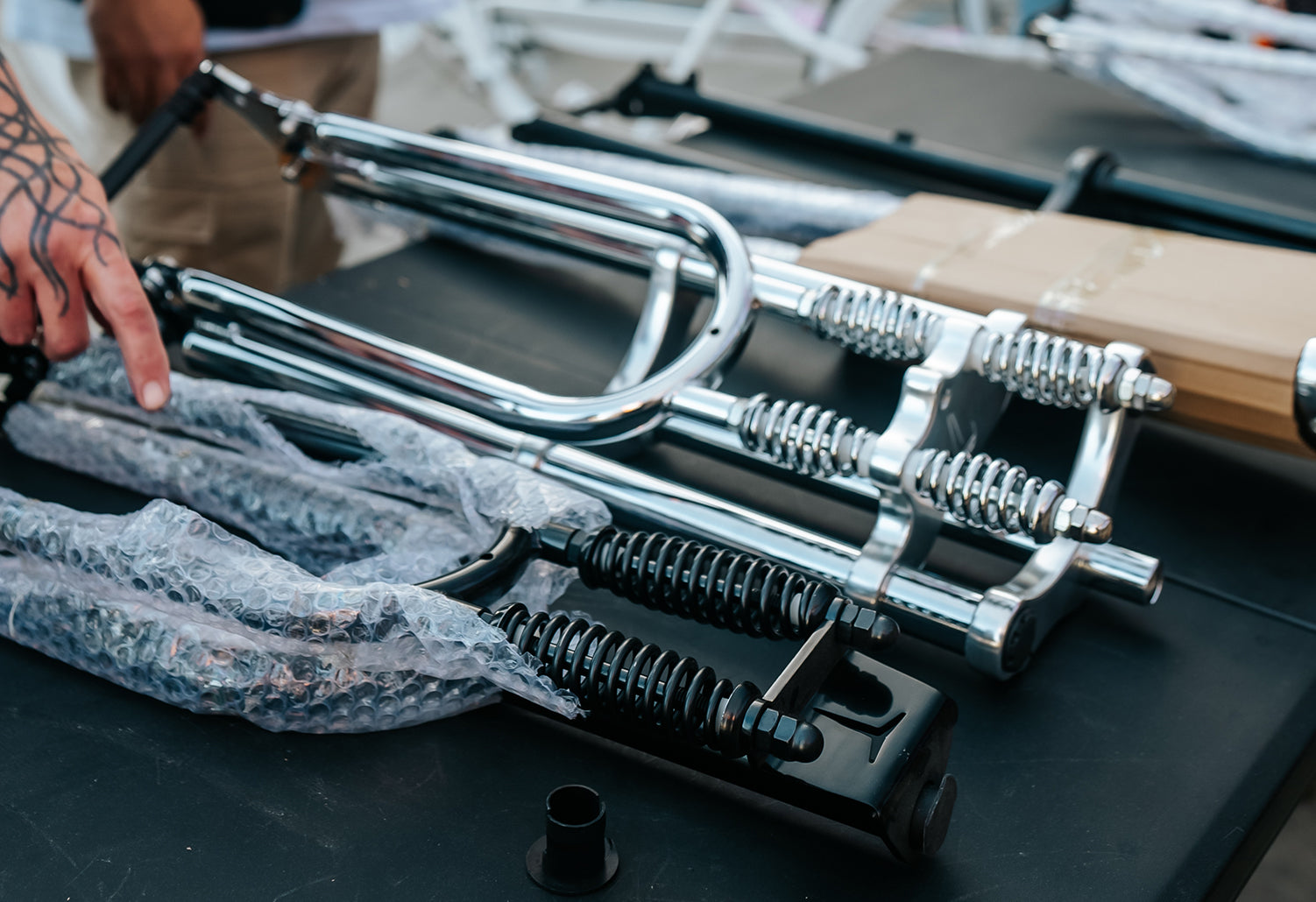
Dual spring forks—often called springer forks—use a visible double-spring mechanical structure instead of an internal damping system. This design is commonly found on classic cruisers, choppers, lowriders, and retro-style stretch bikes.
A perfect example is the Tracer Scorpion Pro DTS 26” Stretch Chopper Cruiser Bicycle
This bike uses a dual spring fork that gives it the signature chopper stance and smooth cruising feel.
How a dual spring fork works
The structure typically includes:
- Upper spring
- Lower spring
- Linkage arms
- Pivot points
- Long fork legs
- Retro triple-tree crown
When the bike hits a bump:
1. The linkage compresses.
2. The springs absorb most of the impact.
3. Some motion is transferred to the lower spring for secondary absorbing.
4. The fork extends back to its original position.
This gives a soft, cushioned, smooth-gliding feeling—perfect for a relaxed ride.
Advantages of dual spring forks
- Classic chopper/cruiser aesthetics
- Very smooth and cushioned on mild bumps
- Simple mechanical system (low maintenance)
- Wide compatibility with fat front tires
- Ideal for low-speed comfort riding
- Matches long-frame stretch cruiser geometry perfectly
Not ideal for:
- Heavy off-road
- High-speed aggressive riding
- MTB-style terrain
Why dual spring forks feel so comfortable
They have a long travel distance, meaning the fork moves more before fully compressing. This gives them a natural, soft, floating feel that riders love on:
- Beach paths
- Boardwalks
- City streets
- Smooth trails
They excel at comfort cruising and are highly favored in chopper-style bicycles.
Further Reading: For a deeper dive into beach cruiser style and comfort, check out “The Ultimate Guide to Beach Cruisers: Style and Comfort.”
5. Rigid Fork: No Suspension, Maximum Simplicity
Rigid forks are exactly what the name suggests—solid, non-moving front forks with no suspension components.
Advantages of rigid forks
- Zero maintenance
- Lighter weight
- Higher pedaling efficiency
- More responsive steering
- Clean, classic appearance
Best for:
- Smooth city roads
- Fitness riding
- Lightweight commuter bikes
- Simplicity-focused riders
Limitations
- Harsh on rough terrain
- Less comfortable over long distances
- Not ideal for high-speed e-bikes
Rigid forks are typically chosen for practicality rather than comfort.
6. Full Suspension: The Ultimate System for Comfort and Performance
Full suspension refers to bikes that have:
- Front shock (front suspension fork)
- Rear shock (rear suspension system)
This combination dramatically increases comfort and allows for high-speed riding on varied terrain.
Why full suspension is becoming so popular
Modern cycling—especially electric biking—has changed the demands on bicycles:
- Faster speeds
- Heavier bike weight
- Mixed terrain
- Longer rides
- Riders prioritizing comfort
Thus, full suspension systems help maintain control, safety, and comfort in today’s riding conditions.
Benefits of full suspension
- Maximum impact absorption
- Better tire traction
- Greater stability at speed
- Less fatigue
- Smoother ride even on rough roads
What is an “e-bike full suspension bike”?
This refers to an electric bicycle that includes both front and rear suspension.
E-bike full suspension bikes offer the best of both worlds:
- Power
- Speed
- Comfort
- Control
At higher electric speeds (20–30+ mph), suspension becomes even more important for handling and safety.
7. Comparing Front Shock, Dual Spring Fork, Rigid Fork & Full Suspension
|
Feature |
Front Shock |
Dual Spring Fork |
Rigid Fork |
Full Suspension |
|
Comfort |
★★★★ |
★★★★ (soft & comfortable) |
★★ |
★★★★★ |
|
Best for |
Mixed terrain |
Chopper / Cruiser |
Smooth roads |
All-terrain |
|
Style |
Modern |
Retro / Chopper |
Classic |
Modern |
|
Maintenance |
Medium |
Low |
Very low |
Medium–High |
|
E-bike suitability |
Excellent |
Good |
Limited |
Excellent |
|
Off-road |
Good |
Low |
Poor |
Excellent |
8. Case Example: Tracer Scorpion Pro DTS Dual Spring System
The Scorpion Pro DTS Stretch Chopper Cruiser uses a beautifully engineered dual spring fork, giving it both style and function.
Key features that enhance suspension comfort:
- Long wheelbase stretch frame
- Wide 26" tires
- Dual spring front fork
- Relaxed ergonomic seating angle
- Chopper-style geometry
This combination provides a smooth, floating, laid-back ride that feels effortless even on longer trips.
Why riders love dual spring forks on Scorpion Pro DTS
- They match the bike’s long, low chopper profile
- They give a soft, comfortable ride
- They enhance the bike’s unique retro appearance
- They require minimal upkeep
For beach cruising, urban riding, and stylish comfort, few systems match the feel of a dual spring fork.
9. What Suspension Should You Choose?
The best choice depends on your riding habits.
Choose Front Shock if you:
- Ride mixed terrain
- Want a smooth everyday ride
- Prefer stability and modern handling
Choose Dual Spring Fork if you:
- Love vintage, chopper, or cruiser style
- Ride mostly flat roads
- Want low-maintenance comfort
- Enjoy the classic “gliding” feeling
Choose Rigid Fork if you:
- Ride only on smooth pavement
- Want low weight and simple structure
- Don’t need comfort-focused suspension
Choose Full Suspension or E-bike Full Suspension if you:
- Need maximum comfort
- Ride long distances
- Travel on rougher roads
- Want higher-speed stability
- Use your e-bike daily
10. Conclusion
Bike suspension greatly affects how a bike rides and handles. Knowing the differences between front shock, dual spring fork, rigid fork, and full suspension helps riders pick the best fit for comfort, terrain, and style.
For a smooth, relaxed ride, a dual spring fork offers comfort and stability. For speed and versatility, especially on e-bikes, front shock or full suspension provides better performance.
The right suspension makes every ride safer, smoother, and more enjoyable.
FAQs
1. What type of bike suspension is best for everyday commuting?
For daily commuting with mixed terrain, a front shock (front suspension fork) usually offers the best balance of comfort, control, and durability.
2. Are dual spring forks good for long-distance rides?
Dual spring forks are ideal for comfortable cruising and relaxed riding, but for long-distance or high-speed routes, a front shock or full suspension provides better performance and reduced fatigue.
3. What is the main difference between a front shock and a rigid fork?
A front shock absorbs bumps and vibrations, offering smoother handling, while a rigid fork has no suspension, giving lighter weight and simpler maintenance but a harsher ride.
4. Do e-bikes benefit from full suspension systems?
Yes. Because e-bikes are faster and heavier, full suspension improves comfort, traction, and safety—especially at speeds above 20 mph or on uneven terrain.
5. Which suspension type is best for cruiser or chopper bikes?
Cruisers and stretch choppers typically use dual spring forks because they provide a soft, gliding ride and match the classic retro style better than modern suspension forks.
Share:
Ultimate Winter Cycling Guide: Stay Fit Indoors or Brave the Cold Outdoors
How to Prevent Your Bike from Rusting in Winter—The Ultimate Guide to Rust-Free Riding